M.A. International Relations · Digital Diplomacy & the Middle East Researcher
Published in academic journals as Zahra AlKaabi
An Iraqi researcher in International Relations, she earned an excellent grade (18.9/20) from Imam Khomeini International University in Qazvin, Iran, for her thesis "The Influence of Iraqi Political Elites on Foreign Policymaking after 2003," successfully defended on 15 June 2026 and yielding a co-authored peer-reviewed publication.
She holds a rare linguistic profile in her field: a B.A. in Hebrew from the University of Baghdad granting direct access to Hebrew-language primary sources, certified Persian, working English, and structured Mandarin training in preparation for doctoral studies.
Her research concentrates on digital diplomacy, digital sovereignty and data governance, the impact of AI on global politics, Middle East regional security, and political psychology and elite decision-making.
Research Mission
A Bridge Between Theory and Practice
Employing multilingual, interdisciplinary methods to analyze Middle East issues and produce critical knowledge that serves informed decision-making.
Academic Vision
Digitally Aware Diplomacy
Contributing to the development of Digital Diplomacy and Cyber Sovereignty studies in the Arab world, and nurturing researchers able to read global politics in its original languages.
4
Peer-reviewed publications
5
Academic languages
5
Verified international certificates
18.9
M.A. grade (Excellent /20)
📥 Download the Full Academic CV
Updated PDF — publications, certificates, and professional & academic experience
Note: publications appear under two name variants — Zahra Alkaabi and Zahraa Al-Kaabi — both registered as alternative published names on the author's ORCID profile.
4
Peer-reviewed works
1
Working paper
3
Publication languages
4
Available article links
Abstract
A comparative study of the EU's GDPR, China's internet governance model, and the American open model, examining how the digital revolution is redefining national sovereignty and extracting policy lessons for digital sovereignty and cybersecurity in developing nations.
Methodology & Contribution
Triple comparative method with textual analysis of legislative documents across the three models. The researcher contributed to the theoretical framework, the developing-nations case analysis, and policy recommendations.
Digital SovereigntyGDPRInternet GovernanceCybersecurityDeveloping Nations
Abstract
An analytical study of how Iraqi political elites have shaped foreign-policy decision-making since the fall of Saddam Hussein's regime in 2003, arguing that weak institutional consolidation and fragmented power structures produced a distinctive pattern of elite influence over Iraq's external relations.
Methodology & Contribution
A qualitative, descriptive-analytical study applying thematic content analysis to Arabic, Persian, and English sources within an integrated theoretical framework combining realism, elite theory, decision-making theory, and interdependence theory, to explain the roles of parties, religious, security, and media elites in shaping Iraq's foreign policy. Zahraa contributed to compiling Arabic-language sources and analysing the political-parties and power-sharing dimension.
Political ElitesIraqForeign PolicyPolitical Decision-MakingPower Sharing
Abstract
An analysis of Arab nationalism's role in shaping contemporary Arab political thought through a comparative study of the Nasser and Gaddafi experiences.
Methodology & Contribution
Comparative historical method with discourse analysis of the two leaders' key speeches and writings. The researcher analyzed Gaddafi's intellectual and political experience and co-formulated the theoretical conclusions.
A political-psychology analysis of Saddam Hussein's personality using the frameworks of Kernberg, Adler, and Lasswell, and its consequences for Iraq's domestic governance and foreign policy.
Methodology & Contribution
Psychopolitical profiling with case studies of historical decisions. The researcher applied the three frameworks and analyzed the resulting foreign policies.
Political PsychologyDomestic PoliticsForeign PolicyNarcissismSuperiorityAggressionSaddam Hussein
Work in Progress
Abstract
Artificial intelligence is changing how governments gather intelligence, simulate crises, and conduct diplomacy. This paper asks what that shift means strategically for foreign policy decision-making, synthesising the opportunities AI creates for intelligence analysis and diplomatic communication, the risks it introduces through algorithmic bias, escalation dynamics in autonomous weapons, and accountability gaps in international law, and the geopolitical consequences of an emerging US–China AI competition. It argues that AI works best as an aid to human strategic judgement rather than a replacement for it, and that without binding global governance mechanisms states are largely left to manage the resulting uncertainty on their own.
Methodology & Contribution
Drawing on Realism, Constructivism, and Bureaucratic Politics — complemented by an Islamic political thought perspective on sovereignty and maṣlaḥa — the paper proceeds through a structured comparative reading of official AI strategies, international instruments, policy reports, and peer-reviewed scholarship (2020–2026). Cases were chosen by maximum-variation sampling: the United States, China, the European Union, and the Global South, with Iraq as the organising reference case. It develops the concept of algorithmic soft power, building on the authors' 2026 article on digital sovereignty, and gives particular attention to Big Tech as non-state actors and to the agency of the Global South. Zahraa is the corresponding author, in collaboration with her thesis supervisor Dr. Mohammad Javad Moosanezhad.
Interlocking fields bridging theory and practice — each with a central research question
01
Digital Diplomacy
How states and foreign ministries employ digital platforms and new communication tools in representation, negotiation, and international crisis management.
"How are platforms like X and TikTok reshaping the hierarchy of traditional diplomatic decision-making?"
02
Digital Sovereignty & Data Governance
Comparative study of the European (GDPR), Chinese, and American data-governance models and their implications for developing nations' cybersecurity.
"Where does national sovereignty lie when data crosses borders without state permission?"
03
AI & Global Politics
The impact of artificial intelligence on balances of power, decision-making, and the nature of conflict and cooperation in the international system.
"Does AI produce a new balance of power, or a technological arms race?"
04
Middle East Regional Security
Reading the region's security complexes amid overlapping international and regional competitions and shifting alliances.
"Can an independent Arab regional security complex be built away from the two poles?"
05
Iraqi Foreign Policy
Post-2003 foreign policy decision-making dynamics, drawing on Arabic and Persian primary sources.
"How do Iraqi elites balance intersecting geopolitical pressures?"
06
Political Psychology
Applying the Kernberg, Adler, and Lasswell frameworks to analyze leadership personalities and their impact on policies.
"To what extent does a leader's personality structure shape their strategic choices?"
07
Comparative Governance Models
Comparative study of governance and technology-management experiences in China, the EU, and the United States.
"Which model best suits developing nations in managing their digital transformation?"
03 · The Path Ahead
Toward a PhD in Digital Diplomacy
A statement of research intent, and where China fits in the next stage of the journey
Zahraa is seeking to continue her research trajectory with a PhD in International Relations, specializing specifically in digital diplomacy and the digital sovereignty of developing states. Her proposed research project starts from the observation that Arabic-language literature on digital diplomacy remains limited compared to its English and Chinese counterparts, even as the Middle East has become a key arena of competition among the major digital-governance models — European, American, and Chinese.
This project builds on the theoretical foundation laid in her peer-reviewed article on digital sovereignty, published in September 2026 (a comparative study of GDPR against the Chinese and American models), extending it toward a broader question: how do states in the region — Iraq specifically — balance these competing models in shaping their digital and diplomatic policies?
Why China?
A governance model worth studying from within
Zahraa chose China as a PhD destination because the Chinese model of internet governance and digital sovereignty is one of the three poles examined in her current research, and because understanding it from within — linguistically and institutionally — gives her analysis a depth unavailable to those who write about it only from the outside. She is currently undergoing structured Mandarin training in preparation for this stage.
Proposed Research Question
Arab digital diplomacy between three governance models
How do small and medium Arab states negotiate their digital sovereignty amid the competition among European, American, and Chinese models? And what role can digital diplomacy play in redefining that sovereignty? — This is the central question Zahraa aims to develop into a doctoral dissertation.
* This statement is indicative and is refined for each application according to the target program and supervisor.
🎓 Interested in supervising this research direction?
Welcoming outreach from faculty and supervisors interested in digital diplomacy and the Chinese digital-governance model
Between Translation, Research, and the Diplomatic Field
Professional, voluntary, and freelance engagements with acquired skills
Across the professional years before and after the M.A., I combined specialized translation, field research, and diplomatic participation — producing an integrated skill set: high-level political translation, multi-source geopolitical analysis, diplomatic field presence, and cultural voluntary work.
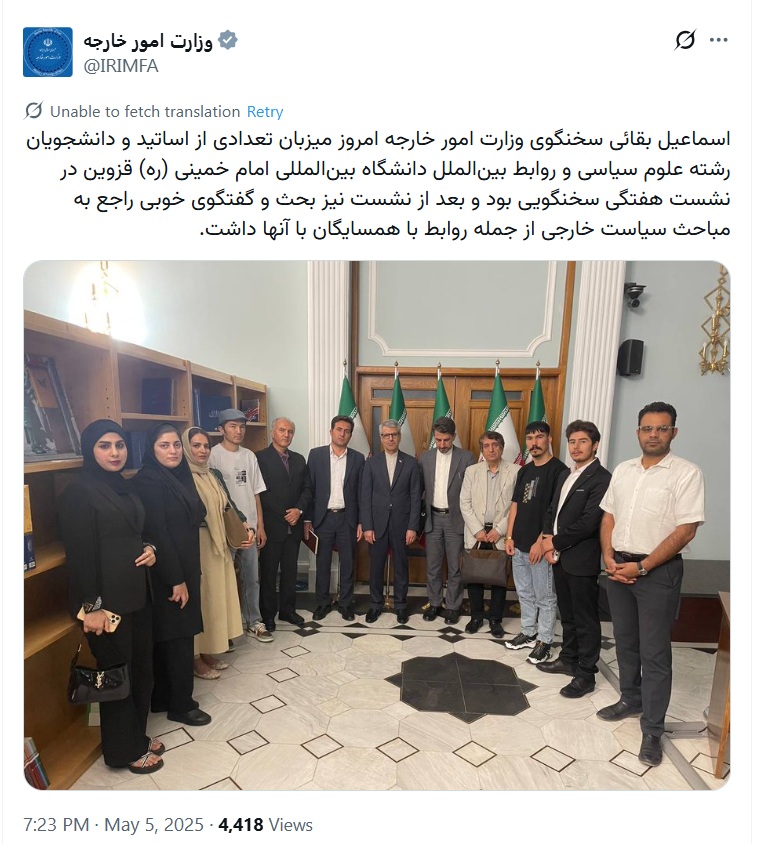
5 May 2025Diplomatic DelegationTehran — Iran
Academic Delegation Member — Iranian Ministry of Foreign Affairs
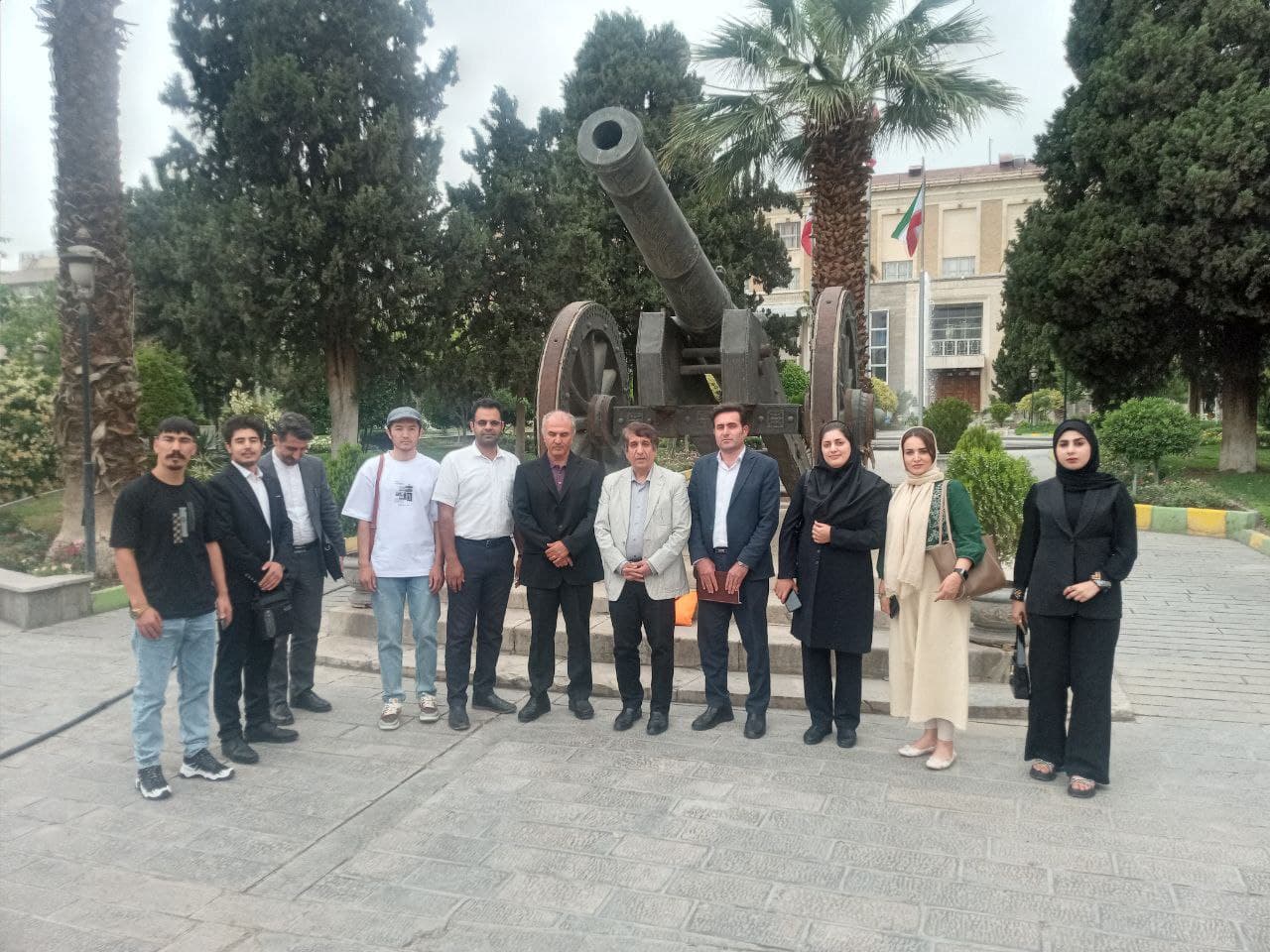
The International Relations department delegation of Imam Khomeini International University visited the Ministry headquarters, attending field diplomatic briefings on regional geopolitics and meeting the Ministry's spokesman at the weekly session.
Visit documentation as published by the Ministry's official account
@IRIMFA ↗
The academic delegation at the courtyard of the Ministry of Foreign Affairs — 5 May 2025
Field DiplomacyProtocolOfficial BriefingsProfessional Networking
2022 — 2023VolunteeringBaghdad — Iraq
Volunteer Peer Mentor & Translator — University of Baghdad
Supported undergraduates with Hebrew political-literature translation and participated in cross-cultural dialogue workshops promoting regional understanding among Baghdad's youth.
High-level translation and geopolitical analysis of political and historical texts from Hebrew to Arabic, with independent research on Middle East security bridging linguistic expertise and IR analysis.
Hebrew → Arabic TranslationPolitical AnalysisPrimary-Source ReadingResearch WritingIndependent Work
05 · Academic Path
From Baghdad to Qazvin
A multilingual research journey with key coursework at each stage
B.A. + M.A.
Two academic degrees
32 units
M.A. International Relations
18.9/20
Excellent grade
2026
Graduation year
2017 — 2021
B.A. in Hebrew — University of Baghdad
College of Languages, Literature & Linguistics
Thesis: "Hebrew Literature and Political Identity." Grade: 68.63/100. This stage built the capacity to read Hebrew political and historical primary sources.
Modern Hebrew LiteratureSemitic LinguisticsHebrew Political LiteratureSpecialized TranslationIsraeli Culture
2024
Persian Proficiency Certificate (C2)
IKIU Persian Language Center · 1403/07/11 SH
Certified academic Persian in listening, reading, writing, and speaking — the second core research language for studying Iranian politics and primary sources.
Member of FIT · Trainee Translator (Hebrew) · No. 8169
BenefitsInternationally recognized membership, access to translator networks, professional practice standards.
Valid until 31/12/2028
07 · Video Library
Activities Documented on Video
Lectures, defenses, and field participation — click any card to watch
08 · Frequently Asked Questions
Frequently Asked Questions
Quick answers about Zahraa Al-Kaabi's background, research, and how to get in touch
Zahraa Mohammed Al-Kaabi — published in academic journals as Zahra AlKaabi — is an Iraqi researcher in International Relations, specializing in digital diplomacy, digital sovereignty, and Middle East politics. She holds an M.A. in International Relations from Imam Khomeini International University (IKIU), Iran, with an excellent grade (18.9/20), and is preparing to pursue doctoral studies in China.
She holds a B.A. in Hebrew Language from the College of Languages, University of Baghdad (2021), and an M.A. in International Relations from Imam Khomeini International University, Qazvin, Iran (2026), where her thesis — "The Influence of Iraqi Political Elites on Foreign Policy-Making after 2003" — was supervised by Dr. Mohammad Javad Moosanezhad and later developed into a peer-reviewed publication.
Her work sits at the intersection of digital diplomacy and digital sovereignty, Middle East politics and foreign policy analysis, political psychology of leadership, and cybersecurity governance — with particular attention to comparative data-governance models across the EU, China, and the United States.
China's model of internet governance and digital sovereignty is one of the central poles in her research on comparative digital-governance frameworks. Studying in China — and undergoing structured Mandarin training in preparation — gives her direct linguistic and institutional access to analyze that model from within, rather than only from the outside.
She has four published peer-reviewed articles — most recently a September 2026 study on redefining national sovereignty in the digital age — and one working paper in preparation, spanning digital sovereignty, Arab nationalism, political psychology, and post-2003 Iraqi foreign policy. Full details, abstracts, and DOI links are available in the Publications section above.
She welcomes inquiries from prospective PhD supervisors, research collaborators, and academic institutions. The fastest way to reach her is by email at zahrakabi99@outlook.com, or via the details in the Contact section.
09 · Contact
Let's Open a Dialogue
For research collaboration, academic invitations, or media inquiries